
November 2026
Financial crime evolves. Can your due diligence keep up?
RepRisk’s latest analysis found that fraud overlapped in 57.4% of risk incidents linked to money laundering globally. Drawing on public sources published between July 1, 2025, and June 30, 2026, the findings highlight the relevance of related business conduct risks to corporate anti-money laundering (AML) due diligence.
Financial crime is already firmly on the agenda of financial sector leaders. In RepRisk’s Business Conduct Risk Intelligence Report 2026, 55% of C-suite respondents cited the combined category of corruption, bribery, and AML/financial crime among their top three material business conduct risks for the preceding 12 months.
# Top material business conduct risks according to C-suite executives

Fig 1. Source: The Business Conduct Risk Intelligence Report 2026, January 2026
# Money laundering risk extends across corporate sectors
RepRisk identified 3,285 companies associated with money laundering in risk incidents. Financial Services and Banks were the most represented sectors, together accounting for 36.6% of all company-sector assignments in the analysis.
# Top five sectors linked to money laundering risk

Fig 2. Number of companies by sector, with percentages showing shares of all company-sector assignments, July 1, 2025–June 30, 2026
Retail, Support Services, and Construction and Materials follow Financial Services and Banks in the sector ranking, extending the relevance of money laundering risk into the businesses banks serve and finance. A client’s sector provides a starting point; external information about the company’s involvement in risk incidents helps banks determine where closer review is needed.
# Related business conduct adds context to AML assessments
Beyond sector exposure, the analysis shows how money laundering connects with other business conduct risks.
# Top five business conduct risks identified alongside money laundering

Fig 3. Number and share of money laundering-related risk incidents linked to each business conduct risk, July 1, 2025–June 30, 2026
Violation of national legislation was the most frequent overlap, reflecting the legal dimension of money laundering-related incidents. Fraud provides a more specific indication of the business conduct risks identified alongside money laundering. For banks, these connections can provide additional context when assessing a corporate client.
Allegations of fraud or tax evasion, for example, may raise questions about the legitimacy of business activities or the origins of funds. Access to the underlying sources can help teams understand the company's involvement and assess the relevance to the client relationship.
# A closer look at Europe: geographic connections
Geography adds another dimension to the assessment. Nearly one in five risk incidents analyzed was linked to at least one location in Europe, including both EU and non-EU countries. The United Kingdom, France, and Russia had the highest counts.
# Top five European locations linked to money laundering risk
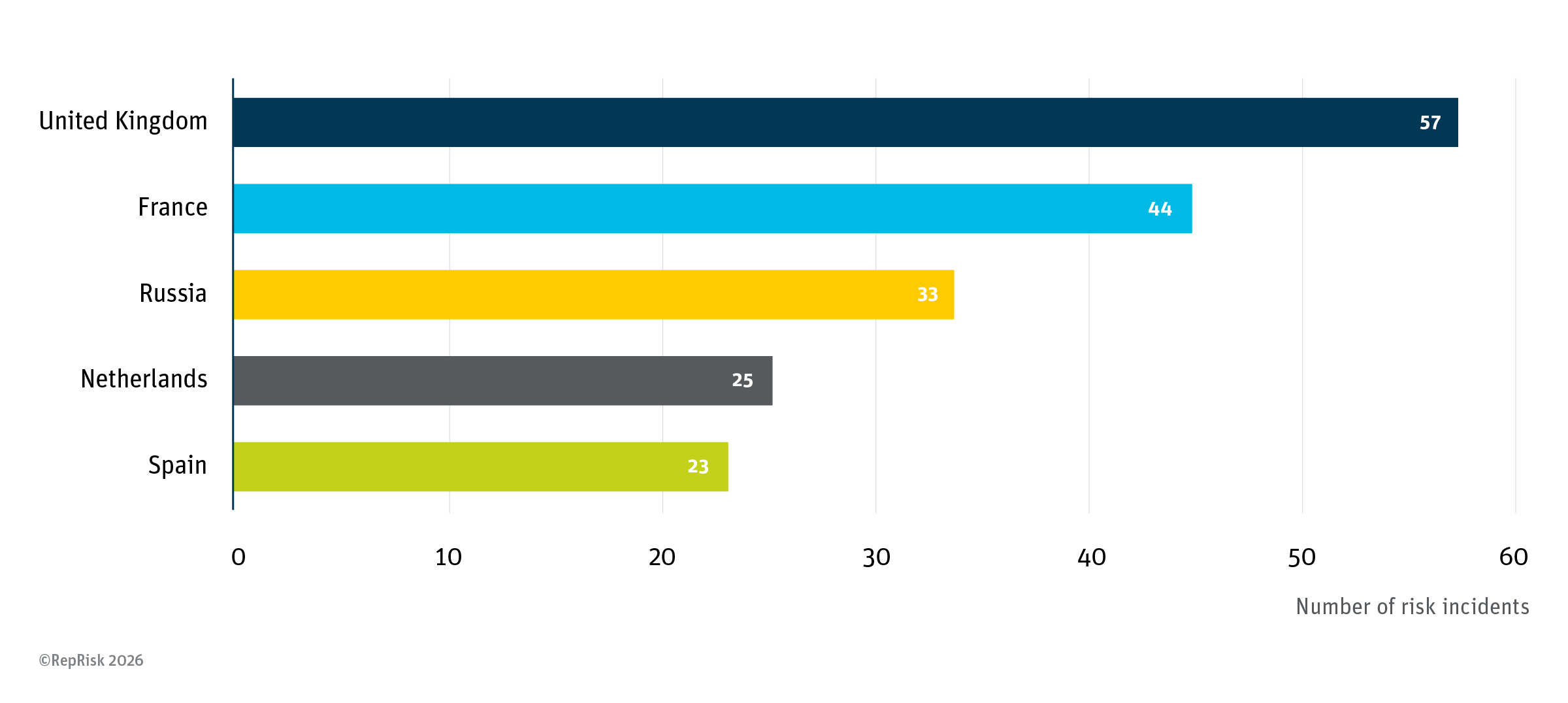
Fig 4. Number of money laundering-related risk incidents linked to each location, July 1, 2025–June 30, 2026
A location linkage may reflect where conduct occurred, where enforcement action took place, or where funds moved. It does not measure national money laundering prevalence or establish flows between countries.
For banks serving clients internationally, headquarters information provides only part of the geographic context. Business conduct risk incidents linked to a client in other jurisdictions can help identify questions to address during due diligence, such as how a subsidiary or local business partner was involved.
# Why ongoing monitoring matters
A corporate client’s risk profile can change between scheduled KYC reviews. New allegations of fraud, investigations, or oversight failures may add information relevant to the bank’s assessment and prompt further due diligence or escalation.
AML frameworks recognize the need to respond to these developments throughout the client relationship. The EU Anti-Money Laundering Regulation (AMLR), generally applicable from July 10, 2027, requires ongoing monitoring of business relationships and transactions under Article 26, alongside reviews of client information when relevant circumstances change or new facts emerge.
Similarly, under the U.S. Bank Secrecy Act (BSA)/AML framework, guidance from the Financial Crimes Enforcement Network (FinCEN) links ongoing monitoring to updating client information and reassessing risk when relevant changes become known.
# Notable regulations and frameworks addressing anti-money laundering
Requirements differ across jurisdictions, but the frameworks below share an emphasis on understanding client risk and applying proportionate measures. International standards and industry guidance provide further direction on governance, controls, and documentation.
Global
The Financial Action Task Force (FATF) Recommendations establish the principal international standards for combating money laundering, terrorist financing, and proliferation financing. They provide a common foundation for national AML/CFT frameworks, including risk-based customer due diligence, beneficial ownership identification, suspicious transaction reporting, and ongoing monitoring.
The Basel Committee on Banking Supervision (BCBS) has established guidelines on the sound management of risks related to money laundering and terrorist financing. These guidelines emphasize the integration of AML/CFT controls into banks' broader risk management frameworks, including customer acceptance, risk assessment, ongoing monitoring, and governance.
The Wolfsberg Group, an association of global banks, provides industry guidance on financial crime risk management, including customer due diligence, correspondent banking, transaction monitoring, and the application of a risk-based approach. Its guidance supports financial institutions in improving the effectiveness of AML controls and prioritizing resources according to risk.
Europe
The EU’s Anti-Money Laundering Regulation (AMLR) introduces a harmonized AML/CFT rulebook that will generally apply from July 10, 2027. It strengthens requirements relating to customer due diligence, beneficial ownership, enhanced due diligence, and ongoing monitoring of business relationships.
Article 26 of the AMLR will require obliged entities to monitor business relationships and customer transactions and review customer information when relevant circumstances change, or new facts emerge. This reinforces the importance of event-driven risk reassessment alongside periodic customer reviews.
The broader EU AML Package also establishes the Anti-Money Laundering Authority (AMLA), which will contribute to consistent supervision and the implementation of AML/CFT requirements across the EU. The accompanying Sixth Anti-Money Laundering Directive (AMLD6) addresses national supervisory arrangements, financial intelligence units, and mechanisms supporting cooperation and enforcement.
In the UK, the Money Laundering, Terrorist Financing and Transfer of Funds Regulations 2017 (MLR 2017) establish requirements for risk assessments, customer due diligence, enhanced due diligence, recordkeeping, and ongoing monitoring. The 2026 amendments refine certain requirements to support a more proportionate and risk-based approach.
North America
The US Bank Secrecy Act (BSA and its implementing regulations form the foundation of the country's AML framework. Financial institutions are subject to requirements relating to customer identification, customer due diligence, suspicious activity reporting, and ongoing monitoring. The Financial Crimes Enforcement Network (FinCEN)continues to shape the regulatory approach through rules, guidance, and enforcement priorities.
The US Anti-Money Laundering Act of 2020 provides a framework for modernizing the US AML/CFT regime, including stronger coordination, information sharing, and a focus on national AML/CFT priorities. Regulatory developments in 2026 continue to reflect efforts to improve the effectiveness of financial crime controls while addressing implementation burdens and emerging risks.
In Canada, the Proceeds of Crime (Money Laundering) and Terrorist Financing Act (PCMLTFA) establishes AML/CTF obligations for reporting entities. These include customer identification, beneficial ownership information, risk assessments, ongoing monitoring of business relationships, and reporting of suspicious transactions. The Financial Transactions and Reports Analysis Centre of Canada (FINTRAC) oversees compliance and issues guidance to support the implementation of these obligations.
Asia Pacific
The Monetary Authority of Singapore (MAS) establishes AML/CFT requirements for financial institutions through sector-specific notices and guidelines. For banks, MAS Notice 626 requires customer due diligence, ongoing monitoring, enhanced measures for higher-risk customers, and appropriate controls to identify and report suspicious transactions.
Hong Kong’s Anti-Money Laundering and Counter-Terrorist Financing Ordinance (AMLO) establishes customer due diligence and recordkeeping requirements for regulated entities. The Hong Kong Monetary Authority (HKMA) provides guidance emphasizing a risk-based approach to customer assessment, ongoing monitoring, and enhanced scrutiny of higher-risk relationships.
In Australia, reforms to the Anti-Money Laundering and Counter-Terrorism Financing Act 2006 strengthen the country's AML/CTF framework. Significant changes took effect in March 2026, including reforms to AML/CTF programs, customer due diligence, and virtual asset services. From July 2026, the regime also expanded to cover additional professional services, including certain legal, accounting, real estate, and trust and company services.
Japan’s Act on Prevention of Transfer of Criminal Proceeds (APTCP) establishes customer verification, transaction recordkeeping, and suspicious transaction reporting obligations. Financial institutions are also subject to Financial Services Agency (FSA) guidelines promoting risk-based AML/CFT controls and ongoing assessment of customer relationships.
# What this means for AML and compliance teams
For AML and compliance teams, the value of external information depends on the conduct described, the company’s involvement, and the evidence behind it. Access to underlying incidents and original sources helps teams assess relevance and document the basis for further review.
RepRisk uses advanced AI, with humans in the lead, to screen more than 175,000 public sources in 100 languages daily. Our research identifies and contextualizes business conduct risks across all sectors and geographies, complementing client information, sanctions screening, and transaction monitoring.
Available through the RepRisk Platform, APIs, and Data Feeds, our business conduct risk intelligence can inform client risk profiles and support existing review processes. Daily updates can support automated review triggers based on internal criteria, helping teams prioritize investigation, enhanced due diligence, and escalation.
Want to learn more about how RepRisk supports AML due diligence?
Request a demo and a RepRisk specialist will contact you.
# About the analysis
Methodology and interpretation
The analysis covers reporting published between July 1, 2025, and June 30, 2026. Publication dates do not necessarily indicate when the underlying conduct occurred.
The analysis uses substories to identify information linked to reported money laundering. A single risk incident may contain multiple substories, allowing different combinations of companies, locations, Issues, and Topic Tags to be recorded separately to accurately reflect the source text. The companies, locations, and additional Issues included in this analysis were extracted from qualifying substories: those tagged with both the Issue “Corruption, bribery, extortion and money laundering” and the Topic Tag “Money laundering.” Each risk incident included in the analysis has at least one qualifying substory.
For overlap with other Issues, the analysis counts additional classifications only within qualifying substories. It excludes classifications appearing solely in other substories within the same risk incident, ensuring that the overlap relates to reported money laundering. Co-occurrence does not establish a causal relationship.
The overlap figures are presented as unique risk-incident counts: each incident is counted once per additional Issue identified within the qualifying substories. Percentages are based on 1,855 unique risk incidents and should not be added together, as Issues may overlap.
The 3,285 companies in the analysis account for 3,713 company-sector assignments, as companies may have multiple sector classifications. Sector percentages use these assignments as the denominator and are additive across sectors.
Financial Services covers activities such as investing, risk management, and financial planning, while Banks covers banking activities involving cash, credit, and other financial transactions. The figures do not measure sector-wide prevalence.
The European location analysis covers 347 unique risk incidents linked to at least one location in Europe. Each incident is counted once per location and may involve multiple locations, so location counts should not be added together to calculate a unique incident total.
A linkage does not establish legal fault. A bank may, for example, be linked to money laundering reporting because it was used as a channel for moving funds, even without direct criticism. The findings reflect monitored public reporting and should not be interpreted as the prevalence of money laundering across sectors or countries.
The analysis concerns companies. RepRisk supports the assessment of corporate clients and counterparties; it does not provide money laundering risk assessments of individuals.
Copyright 2026 RepRisk AG. All rights reserved. RepRisk AG owns all intellectual property rights to this report. This information herein is given in summary form and RepRisk AG and/or the third party contributors to this report make no representation or warranty that any data or information supplied to or by it or them is complete or free from errors, omissions, or defects. Without limiting the foregoing, in no event shall RepRisk AG and/or the third party contributors to this report have any liability (whether in negligence or otherwise) to any person in connection with the information contained herein. Any reference to or distribution of this report must include a link to the content to provide sufficient context. The information provided in this presentation does not constitute an offer or quote for our services or a recommendation regarding any investment or other business decision, and is not intended to constitute or to be used as a substitute for legal, tax, accounting, or other professional advice. Please note that the information may have become outdated since its publication. Should you wish to obtain a quote for our services, please contact us.