
An illustrative use case showing how a global bank can apply RepRisk data to support OECD-aligned due diligence.
# The challenge
A leading global bank had committed to conducting risk-based due diligence in line with the OECD Guidelines for Multinational Enterprises on Responsible Business Conduct (OECD MNE Guidelines). The challenge was translating that commitment into a consistent process across thousands of client and counterparty relationships, while directing limited specialist resources toward those requiring closer investigation.
Company-reported information and high-level risk indicators alone did not provide sufficient insight into potential adverse impacts, including child labor, human rights abuses, pollution, biodiversity loss, corruption, and bribery. The bank needed granular data and access to underlying evidence to understand these concerns and determine appropriate follow-up.
# The solution
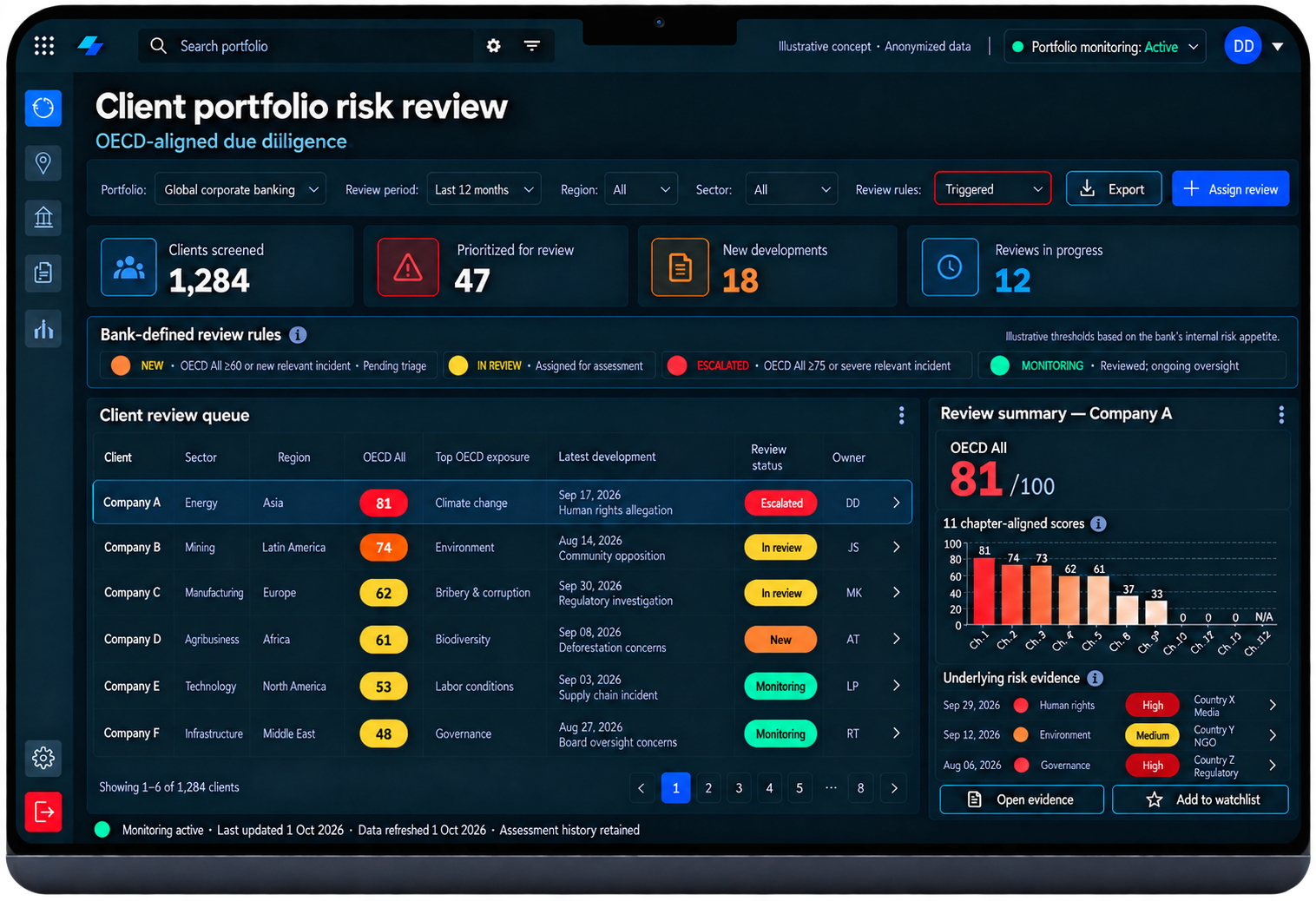
Illustrative dashboard demonstrating how RepRisk data can support a bank’s due diligence process. Company names, figures, and thresholds are for demonstration purposes only.
The bank chose RepRisk for our specialized focus on business conduct risk and high-quality data, underpinned by a transparent, proven methodology. Our independent, outside-in perspective provides a reality check on how companies conduct business around the world. Coverage of public companies and 330,000+ private companies supported due diligence across the bank’s diverse portfolio, while daily updates provided consistent, timely, and actionable insights.
The bank selected RepRisk Due Diligence Scores (DDS) to understand specific risk concentrations across its portfolio. DDS evaluate more than 200 individual factors, including human rights, environmental impacts, governance failures, and corruption, providing a more granular view than a headline risk indicator alone. The DDS OECD MNE Package focused the assessment on factors relevant to the OECD MNE Guidelines. Scores could be traced to underlying incidents and original sources, enabling teams to understand what was driving each risk signal.
The RepRisk Data Feed delivered scores and incident data into an internal portfolio review dashboard. Bank-defined thresholds applied to the overall OECD score flagged relationships requiring specialist attention, while chapter-aligned scores helped assign them to teams with relevant expertise.
These teams used the RepRisk Platform for ad hoc investigations into individual clients and counterparties. Watchlists and alerts kept them informed of new incidents involving selected entities.
# Due diligence in practice: The bank’s review, step by step
# 1. Identify the risk concentration
A corporate client exceeded the bank’s OECD review threshold. Chapter-aligned scores highlighted labor-related risk, prompting an investigation by an analyst with expertise in labor rights.
# 2. Examine the underlying incidents
The analyst examined incidents linked to the client, including allegations of child labor in its operations. The severity of the incidents, who was affected, where they occurred, and the original sources helped establish the context and identify questions for follow-up.
# 3. Request information and determine next steps
The relationship manager requested clarification on the allegations and the client’s response. As the information provided did not sufficiently address the concerns, the specialist team referred the relationship for enhanced due diligence and documented the outstanding questions.
RepRisk informed the process; the bank retained responsibility for assessing the findings and deciding how to proceed with the relationship.
# Why it matters
By integrating RepRisk’s data into portfolio oversight, banks can strengthen due diligence, respond to emerging concerns, and proactively manage reputational risk. This supports the systematic implementation of internal policies and international standards, helping financial institutions put their commitments to responsible business conduct into practice.
Learn more
To understand how your institution can integrate RepRisk’s data into your workflows, request a demo.
Copyright 2026 RepRisk AG. All rights reserved. RepRisk AG owns all intellectual property rights to this case study. This information herein is given in summary form and does not purport to be complete. Any reference to or distribution of this case study must include the entire case study to provide sufficient context. The information provided in this presentation does not constitute an offer or quote for our services or a recommendation regarding any investment or other business decision. Should you wish to obtain a quote for our services, please contact us.