Back

Strengthen OECD-aligned due diligence at scale

Identify, prioritize, and monitor adverse impacts across clients, counterparties, investments, and portfolios.

The global standard for responsible business conduct

First adopted in 1976 and most recently updated in 2023, the OECD Guidelines for Multinational Enterprises on Responsible Business Conduct (OECD MNE Guidelines) establish government-backed expectations for how businesses should identify and address actual and potential adverse impacts on people, the environment, and society.

For organizations, applying these expectations means translating broad principles into repeatable due diligence: identifying potential adverse impacts associated with companies and projects, such as human rights abuses (Chapters II & IV), impacts on ecosystems and biodiversity (Chapter VI), and money laundering (Chapter VII) , determining where closer attention is needed, investigating the available evidence, and monitoring developments over time.

The challenge is doing this consistently and at scale across large company universes and complex business relationships, while looking beyond self-reported information and keeping pace with emerging risks.

50 years of OECD MNE Guidelines

Guidelines adopted

The OECD establishes a government-backed benchmark for responsible business conduct.

Evidence becomes the test
The focus shifts to whether institutions can identify when principles are failing in practice and act before adverse impacts escalate.

RepRisk supports the OECD Due Diligence Guidance’s
six-step framework

1. Embed responsible business conduct

Translate OECD commitments into practical assessment criteria by incorporating business conduct risk indicators, such as child labor, anti-competitive practices, tax evasion, and local pollution, into client onboarding, lending, investment selection, and portfolio-management policies.

Apply policies consistently across companies, portfolios, and markets using standardized indicators, framework mappings, and Due Diligence Scores to support screening and escalation thresholds.

Integrate a shared risk perspective into existing workflows through the RepRisk Platform, APIs, and Data Feeds, enabling risk, compliance, credit, sustainability, and investment teams to work from a consistent evidence base.


2. Identify and assess adverse impacts

Identify potential adverse-impact risks exposure across clients, counterparties, investments, and portfolios, including human rights, environmental, and governance concerns, using outside-in information on real-world corporate behavior from 175,000+ public sources in 100 languages.

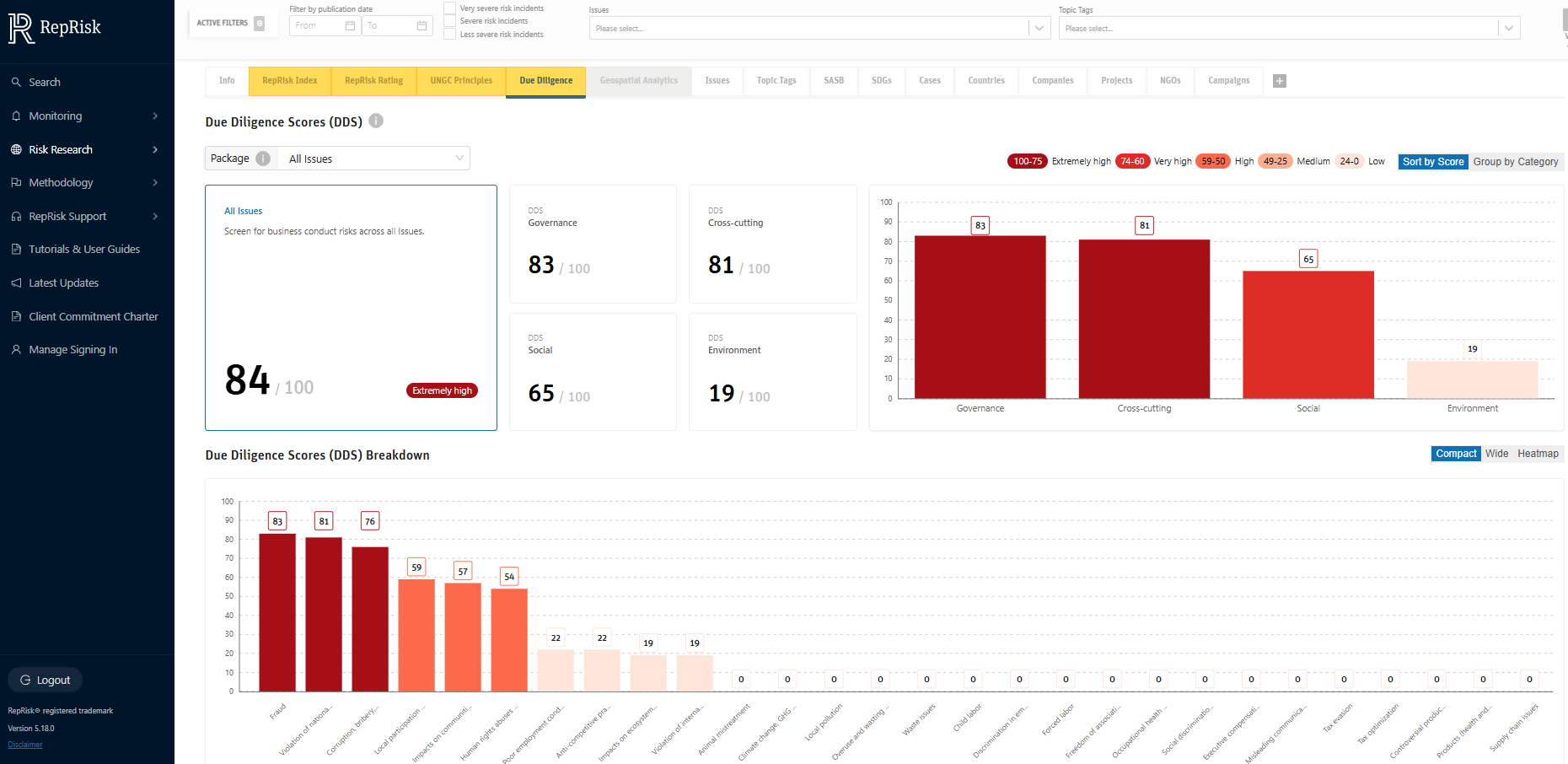
Screen and compare companies using standardized metrics including the RepRisk Index (RRI), RepRisk Rating (RRR), Due Diligence Scores (DDS), and Country-Sector risk information.

Investigate identified concerns through the RepRisk Platform with access to the underlying incidents, specific risk factors, affected stakeholders, severity, countries, and public sources.

3. Cease, prevent, or mitigate adverse impacts

Prioritize companies and issues requiring closer attention using Due Diligence Scores (DDS) and other RepRisk indicators to distinguish the most significant risk exposures across clients and portfolios.

Understand what is driving each result by examining the nature and severity of the impact, affected stakeholders, the company’s involvement, and whether concerns are isolated, recurring, or worsening.

Support engagement, escalation, and internal decision-making with evidence-based information that can inform enhanced due diligence, conditions on financing, stewardship activities, or changes to a relationship or investment.

4. Track implementation and results

Maintain oversight beyond the initial assessment with continuously updated RepRisk data, configurable watchlists, and alerts covering clients, counterparties, investments, and portfolio holdings.

Detect material changes in risk exposure over time by tracking developments in the RepRisk Index (RRI), RepRisk Rating (RRR), Due Diligence Scores (DDS), and underlying risk incidents.

Support ongoing client review, portfolio monitoring, and engagement by integrating updated RepRisk data into existing systems through APIs and Data Feeds.

5. Communicate how impacts are addressed

Document the evidence considered during assessments and decisions using structured RepRisk data linked to the underlying incidents and public sources.

Maintain a consistent record of material developments, review outcomes, escalation decisions, and subsequent monitoring across clients, transactions, investments, and portfolios.

Support internal governance, engagement, and reporting by enabling credit, risk, compliance, sustainability, and investment teams to explain the information considered and the basis for further action.

6. Provide for or cooperate in remediation

Understand the context of reported adverse impacts by examining the relevant incidents, affected stakeholders, risk factors, countries, and public sources available through the RepRisk Platform.

Monitor company responses and subsequent developments using continuously updated risk data and alerts to identify whether concerns continue, intensify, or subside.

Inform engagement and escalation with independent evidence while retaining responsibility for determining the institution’s relationship to the impact and the appropriate response.

Strengthen due diligence across banking and investment
workflows with business conduct risk data

Client onboarding and counterparty reviews

Identify business conduct risks associated with existing and prospective clients and counterparties.

Lending and transaction due diligence

Incorporate business conduct risk into lending, financing, and transaction decisions.

Investment screening and selection

Assess companies consistently during investment research, selection, and portfolio construction.

Portfolio screening and prioritization

Identify higher-risk holdings and exposures requiring further review or engagement.

Enhanced due diligence and engagement

Investigate the incidents, affected stakeholders, and sources behind elevated risk results.

Ongoing monitoring

Detect material developments throughout the client relationship or investment lifecycle.

The data behind OECD-aligned due diligence
Look beyond self reported data with independent
risk lenses to assess, compare, and prioritize risk

RepRisk Index (RRI)
A dynamic 0–100 score quantifying an entity's exposure to business conduct and reputational risk, calibrated for practical thresholds and decay over time.

RepRisk Rating (RRR)
An AAA–D letter rating that blends company-specific exposure with Country-Sector risk, supporting benchmarking and integration in credit and risk models.

UN Global Compact Violator Flag
Identifies companies with high or potential risk of violating UNGC Principles, with visibility into operations vs. supply chain exposure.

Due Diligence Scores (DDS)
Assess and prioritize your exposure to risks such as human rights violations, nature and biodiversity, while aligning with frameworks and regulations including SASB, SFDR, OECD, and the SDGs.

SDG Risk Lens
A mapping of 108 risk factors to the 17 SDGs, showing where a company may be reversing progress, with sector-based benchmarking.

Country–Sector Matrix & Geospatial Analytics
Quantify risk at country, sector, and country-sector levels and assess proximity of extractive projects to biodiversity-sensitive sites for location-aware decisions.

See beyond the headline risk indicator

Due Diligence Scores (DDS) provide granular company-level scores across more than 200 business conduct risk factors. Linked to the underlying incidents, they reveal specific risk concentrations, while the DDS OECD Guidelines for MNE Package brings together relevant scores through a focused OECD lens.

Explore Due Diligence Scores

Why organizations trust RepRisk for due diligence

Human-led intelligence built for action

RepRisk combines advanced AI with human expertise to identify, validate, and contextualize business conduct risk information, delivering structured intelligence that supports informed decisions.

See behind the intelligence

Consistent and transparent methodology

Standardized indicators and assessments enable organizations to evaluate risk consistently, while access to the underlying incidents and sources provides transparency into every result.

Learn about our methodology

Alignment with global standards

RepRisk maps business conduct risks to internationally recognized frameworks, helping organizations translate broad commitments and policies into practical assessment criteria.

Discover our global frameworks

Enterprise integration at scale

Access RepRisk intelligence through the Platform, APIs, Data Feeds, and established data partners, enabling teams across the organization to work from a consistent evidence base.

Explore data integration options

Insights & resources

September 17, 2026
Regulation & standardization

Operationalizing the OECD MNE Guidelines through risk-based due diligence

Responsible business conduct commitments have become firmly embedded across corporate sustainability strategies, investment policies, and financial …
July 01, 2026
Regulation & standardization

The OECD Guidelines at 50

For fifty years, the OECD Guidelines for Multinational Enterprises on Responsible Business Conduct have done something rare in global governance: …
See how RepRisk supports due diligence
under the OECD MNE Guidelines
Request a demo
Important: Platform Maintenance Window

Scheduled maintenance on April 11, 2026, from 14:00 to 17:00 UTC: We will update our core infrastructure. The Platform may be unstable during this time.