
August 2026
When oversight is fragmented, risk hides in plain sight – unless the dots are connected.
# I. What happened?
# A decades-long tenure at Lebanon’s central bank unraveled into a multi-jurisdictional corruption case, coinciding with the country’s financial collapse.
Banque du Liban (BDL) is Lebanon's central bank, responsible for issuing the national currency, managing monetary policy, and overseeing the country's banking and financial sector. For nearly three decades, Riad Salameh served as its governor.
In February 2023, Beirut's public prosecutor charged Salameh and his brother Raja with crimes including money laundering, embezzlement, and illicit enrichment. Subsequently, the United States, United Kingdom, and Canada each imposed sanctions on the former governor in connection with corruption allegations. In July 2026, Salameh failed to appear at a court hearing due to ill health, following an initial hearing in June, and was subsequently arrested while legal proceedings continue.
At the center of the allegations is a claim that substantial sums were siphoned from the central bank over many years, obscured through accounting practices and sustained by an aggressive monetary strategy that offered depositors interest rates of up to 20%. According to prosecutors and investigators, this strategy attracted a continuous flow of fresh capital, effectively financing earlier obligations and concealing the underlying position. When confidence collapsed in 2019 and depositors moved to withdraw their funds, the cycle broke. Between 2019 and 2024, the Lebanese pound lost more than 98% of its value, and millions of people found themselves unable to access their savings. In October 2024, the Financial Action Task Force (FATF) placed Lebanon on its Grey List, complicating cross-border banking relations dampening foreign investment.
The World Bank has described Lebanon's ensuing economic crisis as one of the three most severe globally since the mid-nineteenth century. The country has since become primarily a cash economy, and no comprehensive financial recovery plan has yet been enacted. The banking sector remains insolvent. What distinguishes this case from a typical institutional failure is its breadth of harm: across all socioeconomic strata, the Lebanese population has borne the consequences of the policies, and alleged misconduct, at the very institution entrusted with protecting financial stability.
Lawsuits, investigations, and legal proceedings: Timeline
▪ 2021: Switzerland opens a money laundering investigation and requests judicial assistance from Lebanese authorities.
▪ 2022: France, Germany, and Luxembourg freeze more than USD 130 million in assets.
▪ 2023: Lebanon's top prosecutor charges Salameh with money laundering, embezzlement, and illicit enrichment. France and Germany issue Interpol notices; the US, UK, and Canada impose sanctions on Salameh, his brother, and associates; the Alvarez & Marsal forensic audit documents a USD 51 billion deficit in BDL's net reserves and USD 111 million in unauthorized commissions.
▪ 2024: Salameh arrested in Beirut in September over alleged financial crimes linked to Optimum Invest. Lebanon grey-listed by FATF.
▪ 2025: Salameh released on bail; Lebanese judge issues a presumptive decision on embezzlement and illicit enrichment charges.
▪ 2026: Lebanese prosecutors indict Salameh and two lawyers for suspected embezzlement of approximately USD 44.8 million from BDL's consultancy account, forgery, and illicit enrichment.
# II. RepRisk detection and analysis
RepRisk identified and tracked risk signals consistently throughout the escalation of this case, capturing risk signals across multiple jurisdictions well before the most severe legal consequences materialized.
# Early alerts
RepRisk picked up signals of potential misconduct in 2019, when unverified reports emerged that BDL's budget summary showed a possible USD 21.2 billion discrepancy in reported assets, raising early questions about the accuracy of the bank's financial reporting. These signals predated the first formal investigations by two years. In 2021, RepRisk flagged news reports on investigations in France and Switzerland, as well as NGO complaints across several European jurisdictions. At this stage, no international arrest warrants had been issued, no assets had been seized, and no sanctions had been imposed. Salameh remained in his post as BDL’s governor until July 2023, followed by his arrest in September 2024 and formal indictment in January 2026.
# Quantified risk signals
The RepRisk Index (RRI) is a proprietary metric of reputational risk exposure (0–100) that facilitates an initial assessment of the business conduct and reputational risks associated with a particular entity. BDL's RRI reached a peak of 38 in August 2024, coinciding with the period of intensifying international legal proceedings and asset seizures that preceded Salameh's arrest the following month.
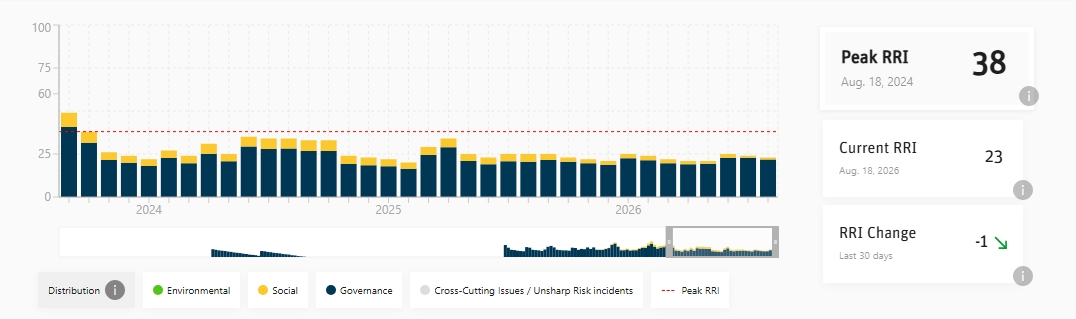
Example RepRisk Index on the RepRisk Platform
# Comprehensive risk profile
Risk incidents related to BDL span multiple jurisdictions. Outside of Lebanon, Switzerland and France are the primary jurisdictions, followed by Germany, Luxembourg, and the United States. By analyzing 2,500,000 documents daily from more than 175,000 public sources across the globe and connecting risk signals to implicated entities, RepRisk provides a unified, cross-border view of risk exposure that would be difficult to assemble through siloed, jurisdiction-specific analysis. This enables clients to identify patterns, trace linkages, and benchmark an entity’s risk profile against global peers using a consistent and transparent methodology – offering an independent perspective that is particularly valuable in contexts where local oversight may be limited.
# A cross-border view of BDL’s risk footprint
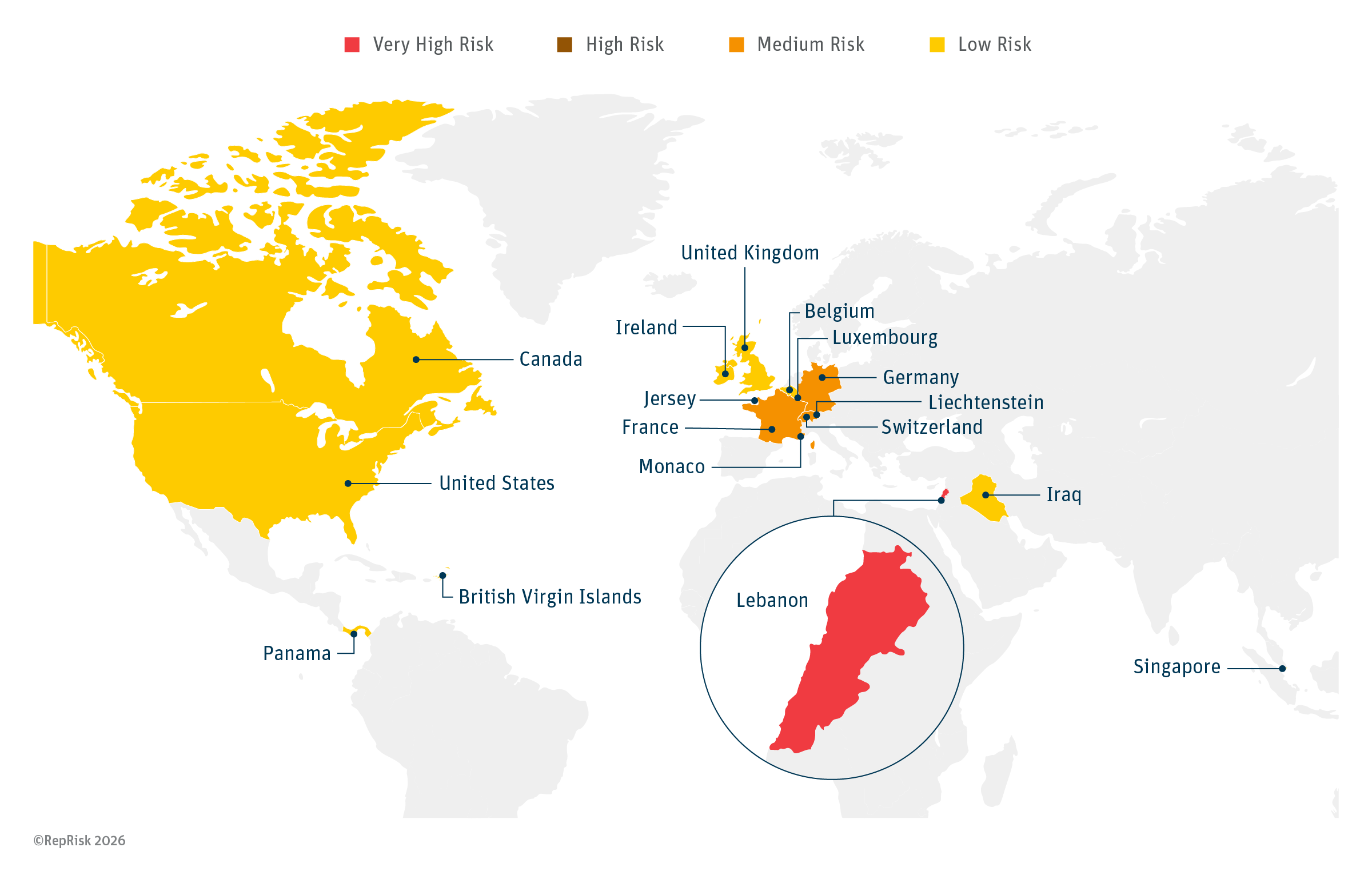
Country business conduct risk exposure over the last 10 years (August 1, 2016 – July 31, 2026). Source: RepRisk Platform.
# III. Impact and lessons learned
The BDL case illustrates the tangible consequences of limited transparency and fragmented oversight in a highly interconnected financial system. Risk signals emerged over several years and across multiple jurisdictions. While publicly available, these early warning signs remained dispersed, delaying a comprehensive understanding of the scale and nature of the underlying risks.
While Lebanese authorities have since advanced banking-sector reform and restructuring initiatives, the country continues to face significant challenges in restoring confidence, recovering deposits, and rebuilding financial stability.
For banks, asset managers, and other financial institutions, the case underscores the importance of independent, cross-border risk intelligence that is both systematic and comparable. Transparency, in this context, extends beyond disclosure: it requires the ability to aggregate information across jurisdictions, standardize its assessment, and connect it to relevant entities in a consistent manner. Without this, benchmarking risk exposure or identifying escalation patterns becomes inherently challenging.
By applying a transparent, rules-based methodology across a vast and diverse set of public sources, RepRisk enables clients to move from fragmented information to a coherent, global risk perspective. This not only supports earlier consolidation and contextualization of emerging risks but also allows for objective benchmarking of entities against peers – regardless of where they operate or the strength of local oversight.
Ultimately, the BDL case highlights a broader lesson: in environments where governance may be constrained or uneven, independent data and methodological transparency are critical for informed decision-making. The ability to connect the dots across jurisdictions is essential for uncovering risks that might otherwise remain obscured until their impacts are fully realized.
Learn more
Discover how you can use RepRisk data to spot emerging business conduct risk: request a demo.
Copyright 2026 RepRisk AG. All rights reserved. RepRisk AG owns all intellectual property rights to this case study. This information herein is given in summary form and does not purport to be complete. Any reference to or distribution of this case study must include the entire case study to provide sufficient context. The information provided in this presentation does not constitute an offer or quote for our services or a recommendation regarding any investment or other business decision. Should you wish to obtain a quote for our services, please contact us.