
July 2026
Viewpoint: The next test is evidence
For fifty years, the OECD Guidelines for Multinational Enterprises on Responsible Business Conduct have done something rare in global governance: they have endured. Introduced in 1976, they gave governments, companies, investors, trade unions, and civil society a shared language for responsible business conduct.
That achievement should not be underestimated. In a fragmented world, common expectations matter. But at fifty, the more important question is no longer whether the principles are right. It is whether institutions can see, early enough, when those principles are beginning to fail in practice.
# The guidelines evolved, but the response gap remained
The OECD Guidelines were never designed as a checklist. They remain non-binding recommendations for enterprises, even as adhering governments commit to promote and implement them through the OECD system. That flexibility has been part of their strength: it has allowed the Guidelines to travel across jurisdictions and remain relevant through globalization, supply-chain expansion, digitalization, and regulatory change.
The 2023 update showed that the framework is still evolving, with stronger expectations on climate change, biodiversity, technology, data, disclosure, corruption, lobbying, and National Contact Points. The message was clear: responsible business conduct is not frozen in the language of the 1970s. It must keep adapting to how companies actually operate.
But adaptation on paper is not the same as changed behavior in the market. Many corporate conduct failures do not arrive without warning. They build. A local protest becomes a pattern. A supplier allegation becomes a portfolio exposure. A governance weakness becomes a regulatory or reputational crisis. A gap between what a company says and what it does becomes evidence.
By the time a case reaches a grievance mechanism, an investigation, or a headline, the risk has often already had a long life. National Contact Points remain an important part of the OECD system, particularly for promotion, dialogue, and remedy, but the real test is whether their lessons help prevent the next case.
# The market still rewards the narrative before the evidence
Responsible business conduct has entered the boardroom. It is referenced in investment policies, procurement standards, stewardship frameworks, banking relationships, and regulatory debates. Yet capital markets still struggle with a basic problem: they often reward visibility before verifiability.
Companies with polished disclosures can appear low risk. Companies operating transparently in difficult contexts may appear more exposed simply because more is known about them. The result is a distortion at the heart of responsible business conduct: the best narrative can travel faster than the best evidence.
This is where the next phase must be different. Responsible business conduct cannot rely on commitments alone. It needs independent, external, and decision-useful signals that help distinguish between noise and escalation. Not to replace judgement. To improve it.
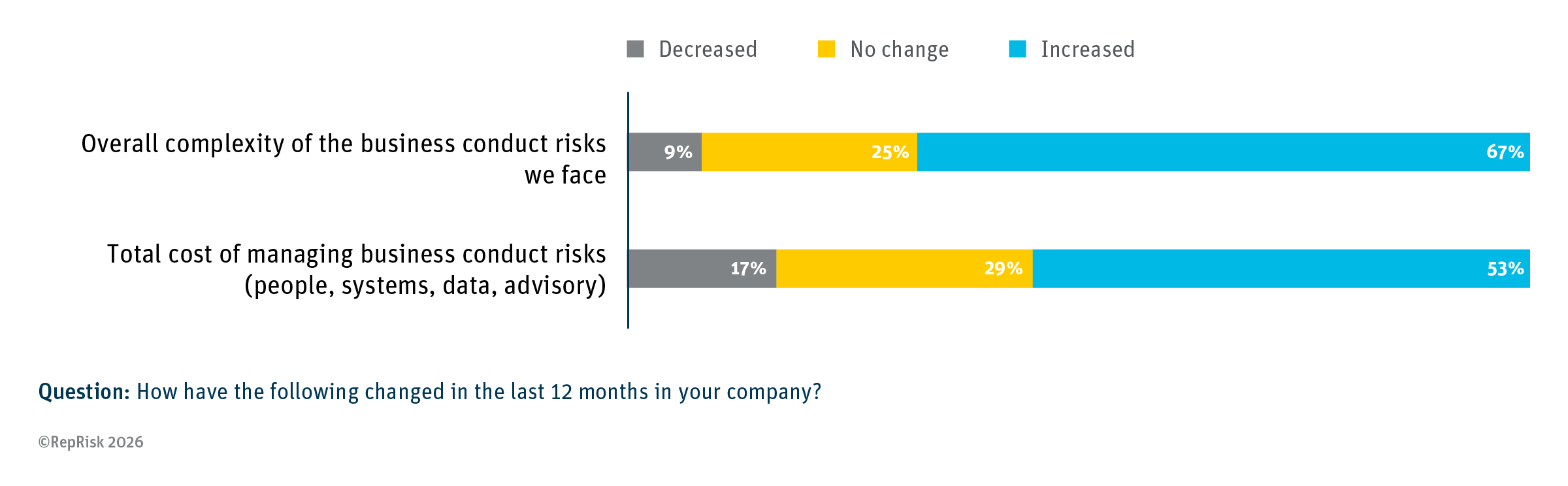
At RepRisk, we see this shift in the data. In our Business Conduct Risk Intelligence Report 2026, conducted with Oxford Economics, 500+ C-suite executives across financial institutions globally were surveyed on the changing risk environment and the role of conduct risk data. Significant business conduct risk incidents rose by 55% from 2023 to 2025, while two-thirds of executives said overall risk complexity had increased over the previous 12 months.
# Changes in the risk environment over the past 12 months
# Prevention is still treated like an afterthought
Eighty-one percent of executives said business conduct risk data will become more valuable to their company over the next two to three years, yet 58% said they increased spend only after a significant incident.
That is the prevention gap in numbers. Everyone agrees that early detection matters. Too many organizations still fund it late.
The future of responsible business conduct will not be decided only by whether companies endorse the right principles. It will be decided by whether those principles are operationalized early enough to shape decisions before harm escalates.
# AI makes evidence quality a governance issue
The anniversary comes at a moment when AI is changing how business decisions are made. That makes the OECD’s 2023 update on technology and data especially timely.
In our latest research, only 16% of executives identified AI-related conduct risks as a top material risk over the previous three years. Looking ahead to the next three years, that figure rises to 56%. As adoption accelerates, risk accelerates with it.
AI does create new categories of responsible business conduct risk. But its broader significance is that it can amplify the consequences of weak evidence.
If weak data, opaque methodology, or hallucinated outputs enter risk, compliance, lending, or investment workflows, errors can spread faster than traditional controls can catch them. That is why human judgement, source transparency, and explainability matter.
Hybrid human-AI approaches are more trusted for material investment and risk decisions than AI-only approaches, a reminder that technology can expand visibility, but it cannot replace accountability.
# From principles to proof
RepRisk turns 20 in the same year the OECD Guidelines turn 50. Our origin story was simple: existing due diligence could not see enough, early enough, so the first RepRisk database was built from 150 companies. Our mission since then has been to provide transparency on business conduct risks to drive positive change, helping decision-makers cut through noise, see business conduct risks more clearly, and act before issues become costly liabilities.
The first 50 years of the OECD Guidelines did more than establish a shared language of responsible business conduct. They shaped expectations, due diligence practices, remedy mechanisms, and the way corporate responsibility is understood across borders. The next 50 years will test whether that language can be matched with evidence, systems, and incentives strong enough to change behavior in time.
Principles are the foundation. Without them, evidence has no direction. The task now is to bring the two together: shared expectations, independent evidence, human judgement, and earlier action.
At fifty, the OECD Guidelines should not only be celebrated for the world they helped shape, but strengthened for the one now taking form – by building a stronger bridge between evidence and action.
Continue reading
What risks will matter most in the years ahead? How are leading institutions strengthening oversight and risk intelligence?
Explore the answers in The Business Conduct Risk Intelligence Report 2026.
Bio - Nicole Streuli-Fürst, Co-Founder and President
Nicole Streuli-Fürst is President and co-founder of RepRisk. Since joining the company in 2007, she has served as Head of Operations and Research and later as Chief Operating Officer. Prior to RepRisk, Nicole worked for the Plant Science Center of the Swiss Federal Institute of Technology (ETH) in Zurich, Switzerland. She holds an Executive Master’s in Business Engineering (EMBE) from the University of St. Gallen in Switzerland and a Master’s degree in Environmental Sciences from Leuphana University of Lüneburg in Germany as well as a Certificate of Advanced Study in Social Management and Social Responsibility from the Zurich University of Applied Sciences in Switzerland.