August 2026
C-suite executives rank human-AI hybrid approaches highest for accuracy, transparency, and accountability
Artificial intelligence has dramatically expanded the ability to process data at scale, but speed alone is not enough. For robust due diligence and reliable risk management, financial leaders want human judgment in the mix.
The Business Conduct Risk Intelligence Report 2026, commissioned by RepRisk in collaboration with Oxford Economics, captures the views of 500+ C-suite leaders across banks, asset managers, asset owners, and other financial institutions. The findings show that human-AI hybrid approaches are now the most widely used and most trusted source of business conduct risk data for investment and risk decisions.
# Hybrid intelligence dominates data sourcing
External data providers play a key role in helping financial institutions monitor business conduct risks across companies, portfolios, and supply chains. And when it comes to methodology, executives show a clear preference for hybrid approaches that combine AI with human expertise: 73% report that their external providers use human-AI hybrid approaches, compared with just 28% that rely on AI-only solutions.
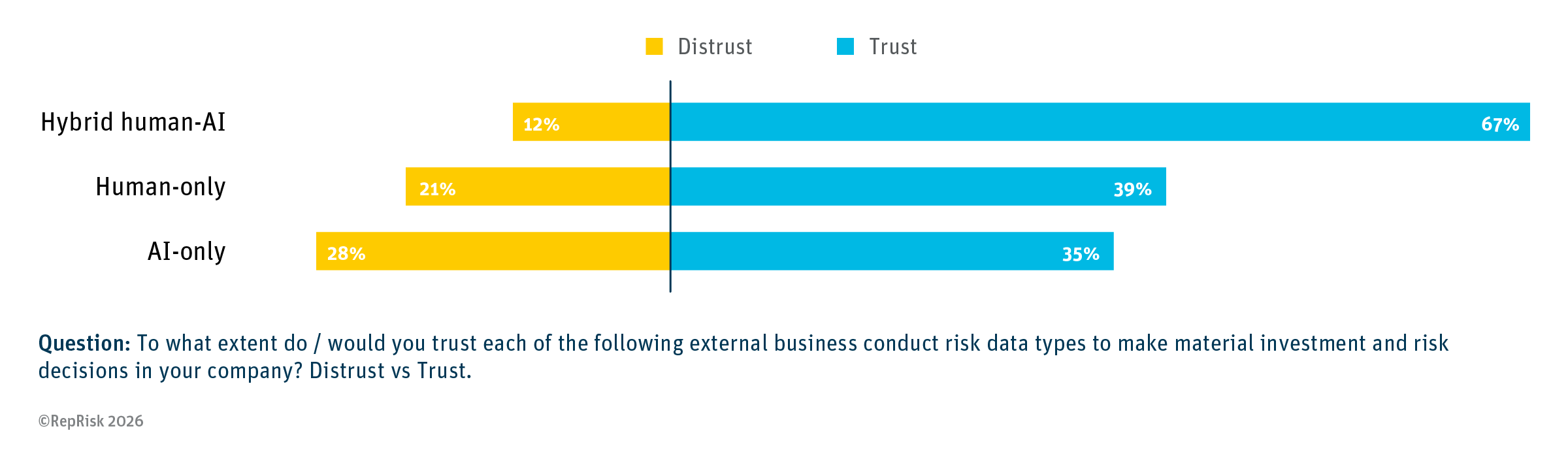
Trust levels follow the same pattern. More than two-thirds of executives trust hybrid approaches most when making material risk and investment decisions, while AI-only approaches attract the highest levels of distrust. The message from financial leaders is clear: when decisions carry financial, reputational, and regulatory consequences, human judgment remains an essential safeguard alongside automation.
# Trust in using data for material decision-making by provider methodology
# Decision-grade quality requires both speed and judgment
Executives don't evaluate data providers on technology alone, they assess whether the data can actually support confident decision-making. On the dimensions that matter most, hybrid approaches consistently outperform. Respondents rank them highest for relevance, accuracy, and transparency, attributes that are critical for investment analysis, risk monitoring, and regulatory reporting. Hybrid approaches also lead on integration with platforms such as Bloomberg and Snowflake, where seamless connectivity is essential for embedding insights into daily workflows.
# Dimensions rated good or excellent quality by external provider methodology
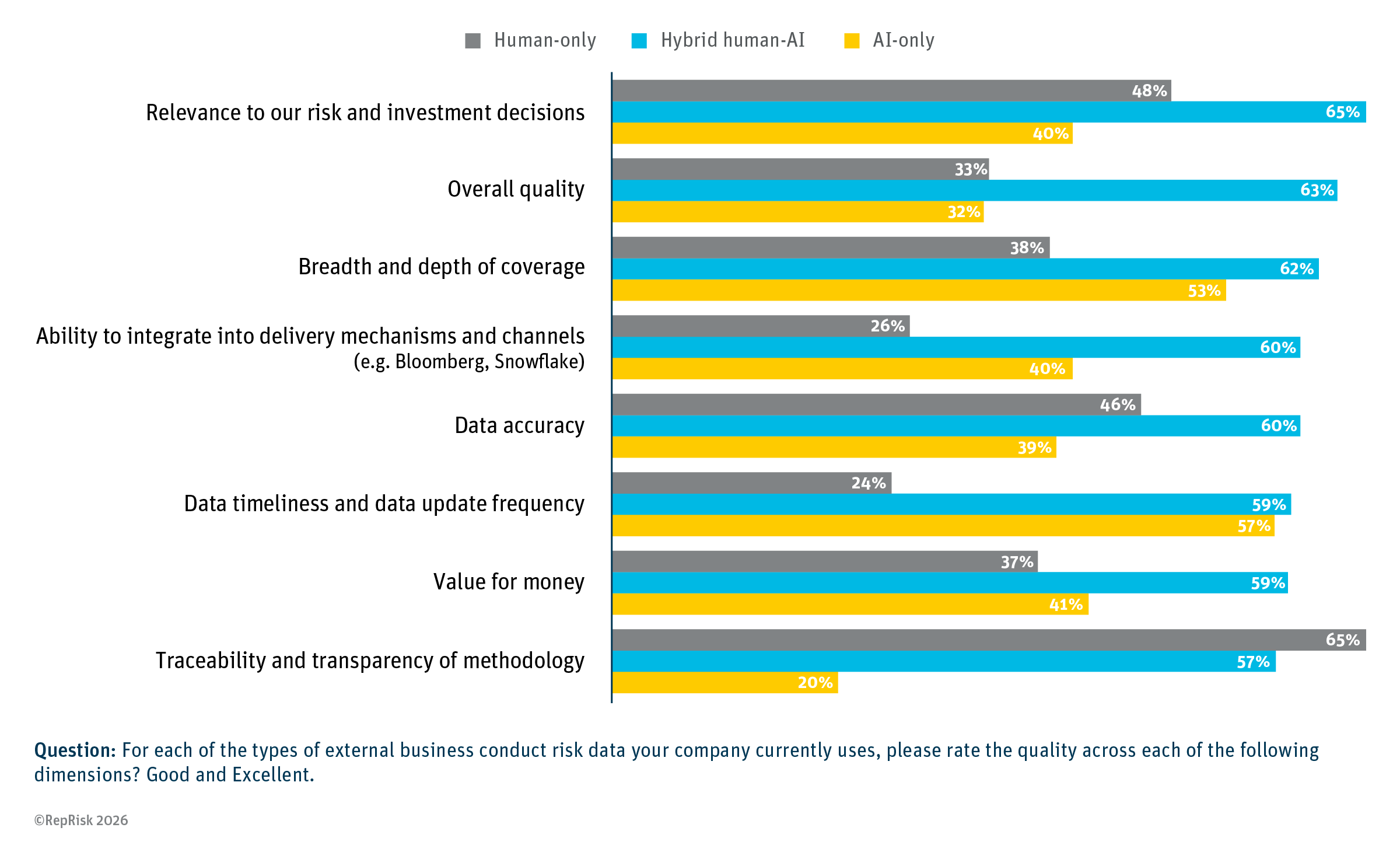
AI-only approaches perform well on speed, timeliness, and breadth of coverage, where automation has clear advantages. But they score significantly lower on overall data quality, traceability, and transparency of methodology – the attributes that determine whether data is defensible in highly compliance-driven sectors such as financial services. Human-only approaches present a different trade-off: stronger analytical judgment, but higher costs, slower processing, and limited scalability.
Hybrid models offer the most balanced solution, combining the speed and scale of AI with the contextual judgment and accountability that decision-grade business conduct risk intelligence requires.
# Trust becomes critical as AI risks rise
The trust gap between hybrid and AI-only approaches is especially significant as AI itself becomes a growing source of business conduct risk. Executives are increasingly cautious about relying solely on AI outputs for decisions that must be explainable, auditable, and defensible.
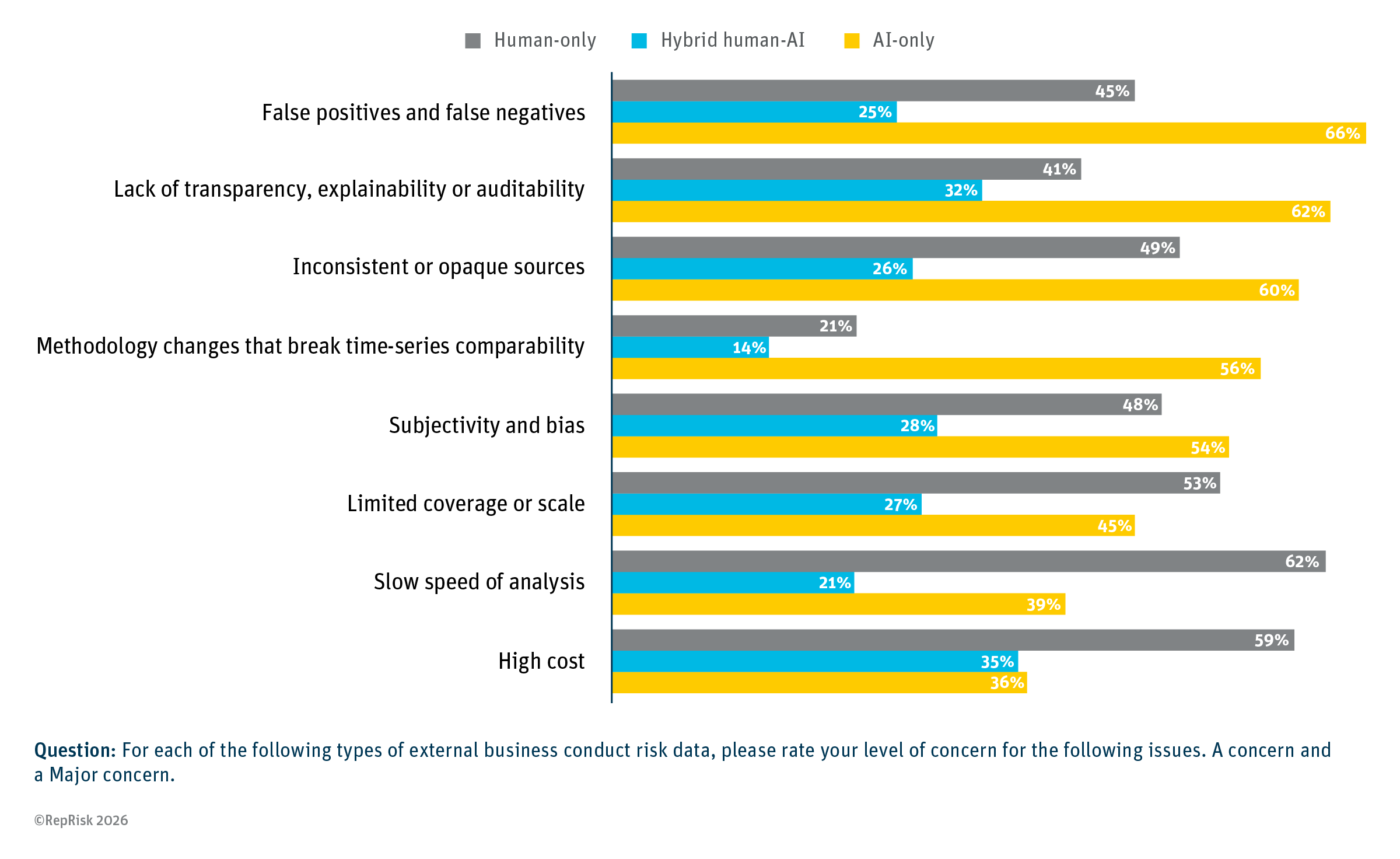
The most prominent concerns include false positives and false negatives, lack of transparency in data sources or methodology, limited explainability of outputs, and methodology changes that break time-series comparability. These are not abstract worries. In long-term monitoring, regulatory reporting, and investment analysis, issues such as hallucinations, misattribution, and limited auditability quickly become operational liabilities with tangible financial and reputational consequences.
# Issues rated a concern by external provider methodology
Financial institutions are responding by increasingly favoring approaches that pair automation with expert validation, ensuring that AI-generated insights remain reliable, explainable, and accountable.
“At LGT Capital Partners, AI supports data collection and structuring, but it does not replace human judgment. [...] Final assessments remain firmly human-led, with clear oversight before any action is taken. AI is a powerful enabler, but it should remain an input, not a decision-maker.”
Alexander Zanker, Head of ESG Analytics, LGT Capital Partners
# Why trust in AI only scales when humans lead
The survey’s findings align directly with RepRisk's core technology philosophy: HI x AI, human intelligence multiplied by artificial intelligence, with humans in the lead. AI delivers speed and scale, and human analysts provide the context, judgment, and source verification that transform raw data into defensible insights. That combination is precisely what executives say they need for high-stakes decisions.
RepRisk operationalizes this through a suite of specialized AI technologies, including fine-tuned large language models, in-house trained and hosted transformer-based models, retrieval-augmented generation, advanced prompt engineering, and AI agents, each continuously refined through human feedback and all embedded in governed workflows. Using specialized models rather than a single large model improves traceability: each step can be tracked and validated, reducing hallucination risk and maintaining the audit trail that financial institutions require.
The 5 key questions to ask any provider using AI
Where does your training data come from and what proportion is verified ground truth versus synthetic or generated data? If you do not know what a model learned from, you do not know its blind spots.
How are you sourcing your data and what is your source universe? Is it curated and controlled, or effectively open web scraping? Can lawful access be demonstrated?
Can you explain how each datapoint is generated and assessed? Is the methodology consistent over time, and can the original evidence be shown every time?
Can you reliably connect your data to our universe – at scale?
Can your outputs be audited, traced, and reproduced? If a result cannot be reproduced, the decision cannot be defended.
# Scaling intelligence without sacrificing quality
Every day, RepRisk processes 2,500,000 documents from more than 175,000 sources. Extracting reliable insights at this scale requires both advanced AI infrastructure and expert human oversight. Analysts' verified decisions feed back into the system, refining models and improving accuracy – a feedback loop that allows coverage to scale without compromising quality.
Because online information can disappear or change, a curated historical dataset ensures risk signals remain comparable across years. This is something AI-only approaches, which are prone to methodology drift and shifting sources, cannot reliably guarantee.
# The future of risk intelligence is hybrid
As financial institutions navigate a more complex risk landscape, spanning AI governance, cyber threats, geopolitical shifts, and tightening regulation, the demand for reliable, decision-grade intelligence will only grow. The survey findings point to one clear conclusion: the future of risk intelligence isn’t AI alone, it’s AI guided by human expertise at scale, applied where it matters most.
Turn business conduct risk into a strategic advantage
RepRisk partners with financial institutions to deliver evidence-based risk data powered by a proven human–AI hybrid approach. If you are ready to strengthen early detection, sharpen decision making, and build resilience across your organization, request a demo of our business conduct risk solutions today.
Copyright 2026 RepRisk AG. All rights reserved. RepRisk AG owns all intellectual property rights to this report. This information herein is given in summary form and RepRisk AG and/or the third party contributors to this report make no representation or warranty that any data or information supplied to or by it or them is complete or free from errors, omissions, or defects. Without limiting the foregoing, in no event shall RepRisk AG and/or the third party contributors to this report have any liability (whether in negligence or otherwise) to any person in connection with the information contained herein. Any reference to or distribution of this report must include a link to the content to provide sufficient context. The information provided in this presentation does not constitute an offer or quote for our services or a recommendation regarding any investment or other business decision, and is not intended to constitute or to be used as a substitute for legal, tax, accounting, or other professional advice. Please note that the information may have become outdated since its publication. Should you wish to obtain a quote for our services, please contact us.
Decision‑grade means suitable for identifying and prioritizing risk exposure as an input into a broader decision‑making process. RepRisk data does not determine legality, compliance, thresholds, or required actions, and does not prescribe investment, procurement, or engagement decisions.