
April 2026
When culture becomes a liability: business conduct risk as an early indicator of governance failure
# I. What happened
Years before WeWork's USD 47 billion valuation collapsed into bankruptcy, external indicators were emerging about the company’s governance, leadership conduct, and treatment of employees – signals that pointed to a culture resistant to accountability.
WeWork opened its first shared workspace in New York City in 2010, shortly after its founding. Within a decade, the company had grown to hundreds of locations in dozens of countries, an expansion fueled by aggressive long-term office leasing and unprecedented levels of venture capital funding.
By 2019, WeWork was valued at USD 47 billion, but was burning through cash at an alarming rate. When the company filed to go public that year, its IPO prospectus laid bare the scale of its problems: losses of approximately USD 1.9 billion in 2018, a corporate structure that concentrated voting control in founder Adam Neumann, and a series of conflicts of interest stemming from Neumann personally profiting from his dealings with the company.
Investor confidence collapsed, and the IPO was withdrawn. SoftBank stepped in with an emergency rescue package, Neumann was forced out, and WeWork's valuation plummeted to around USD 9 billion. The company eventually went public in 2021 via a special purpose acquisition company (SPAC) merger, but continued to post heavy losses before ultimately filing for Chapter 11 bankruptcy protection in November 2023 and reemerging as a private entity in June 2024.
Timeline
▪ 2010: WeWork Companies Inc opens first shared workspace in New York City.
▪ January 2019: WeWork valued at USD 47 billion.
▪ August 2019: WeWork files for IPO, showing losses of USD 1.9 billion.
▪ September 2019: Adam Neumann steps down as CEO amid allegations of self-dealing. WeWork submits request to withdraw IPO
▪ October 2021: WeWork goes public at a USD 9 billion valuation following merger with special purpose acquisition company.
▪ November 2023: WeWork files for Chapter 11 bankruptcy with a valuation of USD 44.5 million.
▪ May 2024: WeWork exits bankruptcy as a privately held company and renamed to WeWork Companies LLC.
From early on, WeWork’s extraordinary growth drew scrutiny over its corporate governance and culture, as well as the treatment of its workforce. The scrutiny included reports on WeWork’s settlements with the Illinois and New York attorneys general over the company’s extensive use of non-compete agreements, as well as former employee lawsuits related to alleged workplace sexual assault in 2018 and gender and age discrimination in 2019. In the months that followed, WeWork faced additional legal complaints alleging workplace discrimination and retaliation against whistleblowing employees. In early 2019, the Wall Street Journal reported that WeWork’s founder and then-CEO Adam Neumann had made millions of dollars by leasing his own properties to the company.
Following WeWork’s IPO failure and subsequent valuation drop, the company continued to struggle with legacy issues left by former leadership. In addition to a state attorney general investigation into self-dealing allegations against Neumann, there was also a class-action lawsuit filed by the company’s minority shareholders alleging breach of fiduciary duty, and several additional legal actions over alleged workplace discrimination and sexual harassment.
# II. RepRisk detection and analysis
While investor enthusiasm and valuations continued to rise after WeWork’s founding in 2010, RepRisk data was already capturing negative signals from as early as 2015, years before concerns surfaced in financial disclosures. From 2018 onwards, RepRisk's database was surfacing a pattern of criticism around WeWork's treatment of its workforce: anti-union practices, poor working conditions, sexual harassment, gender discrimination, and retaliation against whistleblowers. Collectively, these incidents pointed to an organization where internal accountability was weak and leadership operated with limited oversight.
# Early alerts
WeWork’s RepRisk Index (RRI) reached the medium risk threshold in 2015 and 2018, when WeWork was linked to allegations of unfair employment practices. The RRI surpassed the high- risk threshold in 2019, when the company was subject to growing regulatory and legal turmoil following a failed IPO.
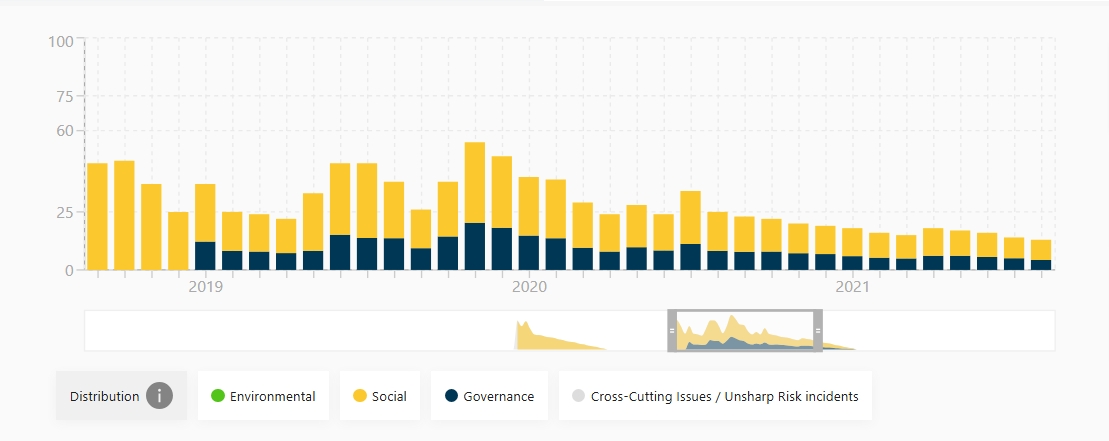
RepRisk’s RRI reached a peak in November 2020
# Focused risk signals
The risk signals flagged by RepRisk were not isolated incidents. They clustered around governance failures and workforce practices, categories that historically correlate with weak internal controls and elevated litigation risk.
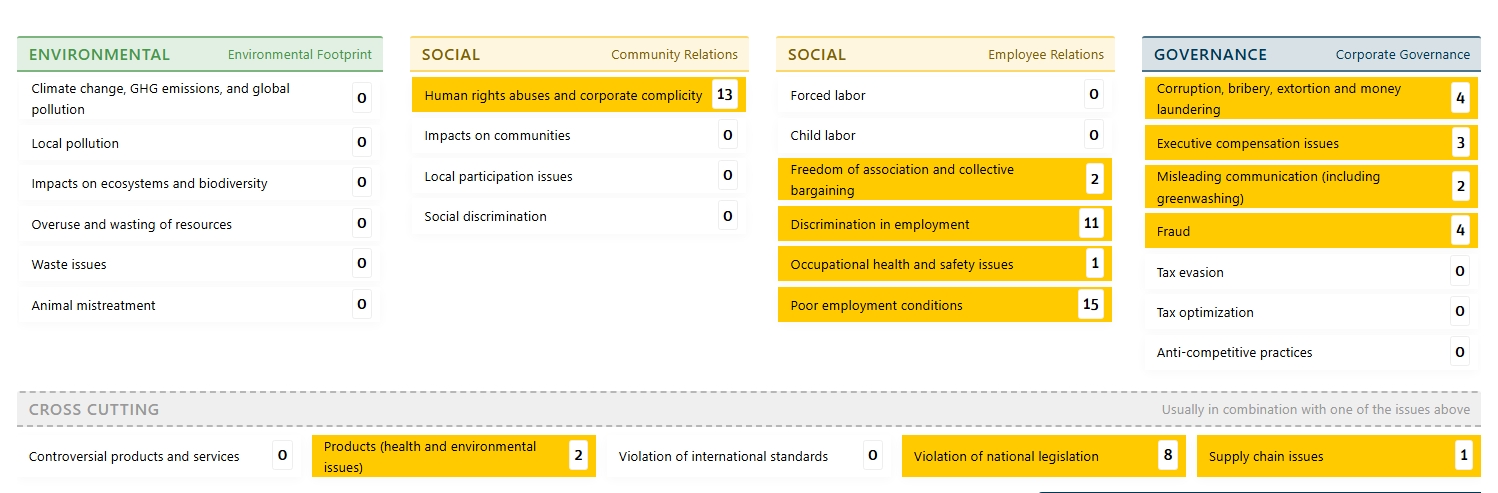
Example RepRisk Issues associated with WeWork Cos Inc
# III. Impact and lessons learned
WeWork's collapse is often analyzed through financial hindsight: overleveraged real estate, unsustainable losses, and a failed IPO. But years before these risks materialized on the balance sheet, third-party business conduct risk data was already surfacing a different set of warning signs.
The recurring risk incidents flagged by RepRisk pointed to a pattern of weak internal controls, limited accountability, and a leadership culture that prioritized rapid expansion over sustainable governance.
The story of WeWork’s rise and fall is a reminder that business conduct risk data is not simply an ethical overlay or a compliance checkbox. It’s an early, decision-relevant lens into how an organization is managed. When such risks persist and go unaddressed, reputational vulnerabilities inevitably translate into financial consequences.
Learn more
Discover how you can use RepRisk data to spot emerging business conduct risk: request a demo.
Copyright 2026 RepRisk AG. All rights reserved. RepRisk AG owns all intellectual property rights to this case study. This information herein is given in summary form and does not purport to be complete. Any reference to or distribution of this case study must include the entire case study to provide sufficient context. The information provided in this presentation does not constitute an offer or quote for our services or a recommendation regarding any investment or other business decision. Should you wish to obtain a quote for our services, please contact us.