
July 2026
# I. What happened?
# Why early detection of reputational and operational risk matters
The Boeing Company’s repeated safety, conduct, and governance failures around the 737 MAX led to criminal charges and fines, multi‑year regulatory scrutiny, and sustained credit‑rating pressure.
The Boeing Company (Boeing) is one of the world’s largest aerospace and defense companies, manufacturing commercial aircraft and defense systems, employing tens of thousands of people worldwide. Within the last decade, two fatal crashes, a 20-month global grounding, and sustained criminal and regulatory proceedings have combined to produce one of the most consequential business conduct crises in the history of commercial aviation.
In connection with the crashes of Lion Air Flight 610 (2018) and Ethiopian Airlines Flight 302 (2019), investigations found that a new flight‑control system (MCAS) could repeatedly push the aircraft’s nose down based on a single faulty sensor input, and that Boeing had withheld critical information about this system from the Federal Aviation Administration (FAA) and airlines during certification and pilot training. As a result, the 737 MAX fleet was grounded worldwide, disrupting airline operations and Boeing’s production.
In January 2021, Boeing entered into a Deferred Prosecution Agreement (DPA) with the DOJ, agreeing to pay more than USD 2.5 billion and accept enhanced compliance oversight, in lieu of an immediate criminal conviction.
In 2024, the US Department of Justice revived a criminal conspiracy charge against Boeing after concluding that Boeing had violated the terms of the 2021 DPA. Rather than proceeding to trial, Boeing reached a USD 1.1 billion settlement that included a USD 243.6 million criminal fine, USD 444.5 million in victim compensation, and mandatory safety investments, following which the criminal conspiracy charge was dismissed, although victim families criticized the agreement as insufficient. A separate Alaska Airlines 737 MAX 9 incident in January 2024, when a cabin panel (door plug) blew out mid‑flight, reinforced concerns about Boeing’s quality‑control and safety culture and triggered further regulatory scrutiny and production limits.
Subsequent crashes involving Boeing aircraft — a Jeju Air 737-800 in South Korea in December 2024 and an Air India 787-8 Dreamliner in India in June 2025 — generated further risk incidents across Boeing’s commercial programs, reinforcing the ongoing nature of the company’s risk exposure.
Boeing’s reputation as a trusted manufacturer of safe and reliable aircraft has been severely damaged, with long‑term consequences for investor confidence, regulatory relationships, and stakeholder trust that continue to materialize.
Lawsuits, enforcement actions, and public scrutiny: Timeline
▪ 2018 & 2019: Two 737 MAX crashes in Indonesia and Ethiopia kill 346 people; worldwide grounding follows and investigations are opened into Boeing’s design and certification practices.
▪ January 2021: Boeing enters into a deferred prosecution agreement (DPA) with the U.S. Department of Justice (DoJ) relating to fraud‑conspiracy charges over misleading the FAA, paying more than USD 2.5 billion in total.
▪ January 2024: A door plug panel detaches from an Alaska Airlines 737 MAX 9, prompting emergency landing, FAA investigations, and temporary grounding and inspections of certain MAX 9 aircraft.
▪ April 2024: Moody’s, S&P Global Ratings, and Fitch each revise their outlooks on Boeing to negative, citing ongoing safety concerns, production disruptions, and projected cash flow shortfalls.
▪ July 2024: The DOJ revives its criminal conspiracy charge against Boeing after concluding the company violated the 2021 DPA; Boeing reaches a USD 1.1 billion settlement, including a USD 243.6 million criminal fine, USD 444.5 million in victim compensation, and safety investments, and the charge is subsequently dismissed.
▪ December 2024: A Jeju Air Boeing 737-800 crashes at Muan International Airport in South Korea, killing 179 people. Investigations cite a bird strike, potential pilot decision errors, and inadequate airport safety measures, including a concrete wall at the end of the runway, as contributing factors.
▪ June 2025: A Boeing 787-8 Dreamliner operated by Air India crashes shortly after takeoff in Ahmedabad, India, killing 260 people. The Aircraft Accident Investigation Bureau produced a preliminary investigation report attributing the crash to a fuel switch issue.
# II. RepRisk detection and analysis
RepRisk identified and tracked risk incident warning signs well before the legal and reputational crises reached their peaks.
# Early alerts
Over many years, public information pointed to growing concerns about Boeing’s safety culture, internal reporting, and governance. This included whistleblower allegations, congressional hearings, and investigative reporting linking cost and schedule pressure to engineering compromises. RepRisk was tracking these signals from 2007 onward, well before Boeing entered the 2021 DPA and years before the legal and financial consequences peaked in 2024. At the point RepRisk first flagged elevated risk, no criminal charges had been filed, no DPA had been agreed, and no credit rating outlooks had been revised.
Drawing on RepRisk’s 20-year history of business conduct risk data, 19 of the risk incidents linked to Boeing were classified as severe or very severe cases of negligence.
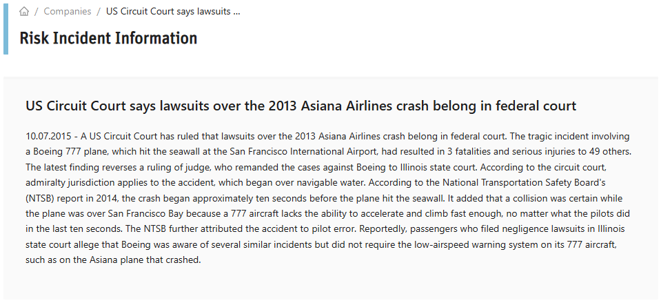
Example risk incident summary on the RepRisk Platform
# Quantified risk signals
The RepRisk Index (RRI) is a proprietary metric of reputational risk exposure (0–100) that facilitates an initial assessment of the business conduct and reputational risks associated with a particular entity. Boeing’s RRI score showed significant fluctuations aligned with legal developments.
In 2017, the year prior to the crash of the Lion Air Flight – Indonesia in 2018, Boeing’s average RRI was 44.5, with 37 total risk incidents recorded by RepRisk.
In 2018 the RRI rose to 53, and in 2019 it rose further to 61.
Boeing’s RRI peaked at 70 in August 2024, placing it in the very high risk band (60–74), coinciding with intensifying legal proceedings and credit rating pressure. As of May 2026, the RRI stands at 57, in the high risk band (50–59), reflecting sustained media and stakeholder scrutiny across multiple aircraft programs.
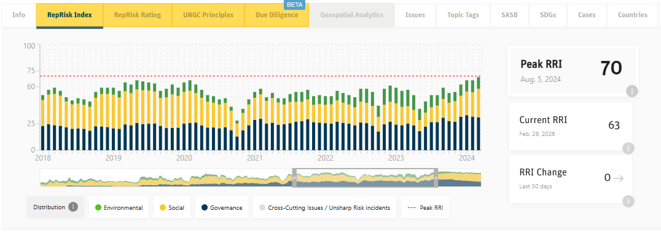
Example RepRisk Index on the RepRisk platform
# Focused risk profile
Boeing’s risk profile is dominated by product safety and health issues, fraud, and corporate governance. This relfects both the structural failures around the 737 MAX certification and the regulatory misrepresentation that underpinned them. RepRisk tracked more than 1,100 risk incidents linked to Boeing since 2001, with incidents spanning 59 countries over the past decade, underscoring the global reach of the company’s risk exposure.
# Top 10 Boeing Risk Incidents by Issue Type and Severity (2007-2025)

# III. Impact and lessons learned
- Financial impact:
- The 2021 DPA required Boeing to pay more than USD 2.5 billion in total to resolve the original fraud-conspiracy charge. When the DOJ concluded Boeing had violated the DPA, a subsequent USD 1.1 billion settlement resolved the revived criminal charge.
- The 737 MAX grounding and subsequent production and delivery disruptions significantly reduced revenue and cash flow; Moody’s, S&P, and Fitch each downgraded their outlooks, placing Boeing just above speculative grade and increasing its cost of capital relative to pre-crisis levels.
- Repeated inspections and FAA-imposed restrictions on production rates have constrained Boeing’s ability to ramp output, compressing cash flow and affecting long-term competitiveness.
- Regulatory and legal impact
- The USD 1.1 billion settlement imposed mandatory safety and compliance investments and extended DOJ oversight of Boeing’s internal processes. A shareholder class action lawsuit was also certified by a US court in March 2026, underscoring the depth and continuity of legal intervention into Boeing’s operations.
- Judicial scrutiny of settlement terms and criticism from victims’ families highlight continuing legal and reputational exposure beyond the immediate criminal fine.
- Reputational and stakeholder impact
- Boeing’s standing as a benchmark for aviation safety has suffered prolonged damage. Years of negative media coverage centered on regulatory disclosures, whistleblower treatment, and the company’s crisis response have eroded trust among airlines, regulators, investors, and the travelling public.
# Consequences for counterparties
- Airlines and lessors
- Airlines operating the 737 MAX faced fleet groundings, schedule disruptions, and capacity constraints; many were required to negotiate compensation with Boeing and revise fleet-planning and route strategies, increasing operational costs and reducing flexibility.
- Banks and investors
- Banks, bond investors, and equity holders faced heightened credit-risk volatility and pronounced share-price erosion across major incident and enforcement milestones, reflecting the sustained market uncertainty generated by Boeing’s multi-year crisis.
# IV. Lessons learned
The Boeing case demonstrates how safety and product-quality failures, compounded by misrepresentation to regulators, can escalate into a multi-year business conduct crisis with substantial legal, financial, and reputational repercussions. Systematic monitoring of business conduct risk signals could have highlighted Boeing’s elevated risk profile earlier. And, as this case shows, that need for monitoring does not diminish once a legal chapter closes. RepRisk’s combination of advanced AI with expert human analysis and deep domain expertise offers the transparency and foresight needed to protect assets, uphold corporate integrity, and maintain stakeholder trust.
Learn more
Discover how you can use RepRisk data to spot emerging business conduct risk: request a demo.
Copyright 2026 RepRisk AG. All rights reserved. RepRisk AG owns all intellectual property rights to this case study. This information herein is given in summary form and does not purport to be complete. Any reference to or distribution of this case study must include the entire case study to provide sufficient context. The information provided in this presentation does not constitute an offer or quote for our services or a recommendation regarding any investment or other business decision. Should you wish to obtain a quote for our services, please contact us.