July 2026

“The market’s attention moves quickly, but business conduct risks have a much longer memory. Twenty years of consistent data reveal what is fading, what is returning, and what is only beginning to emerge – helping decision-makers act before today’s overlooked issue becomes tomorrow’s material exposure.”
Philipp Aeby
CEO and Co-Founder of RepRisk
# One ranking. Four different stories.
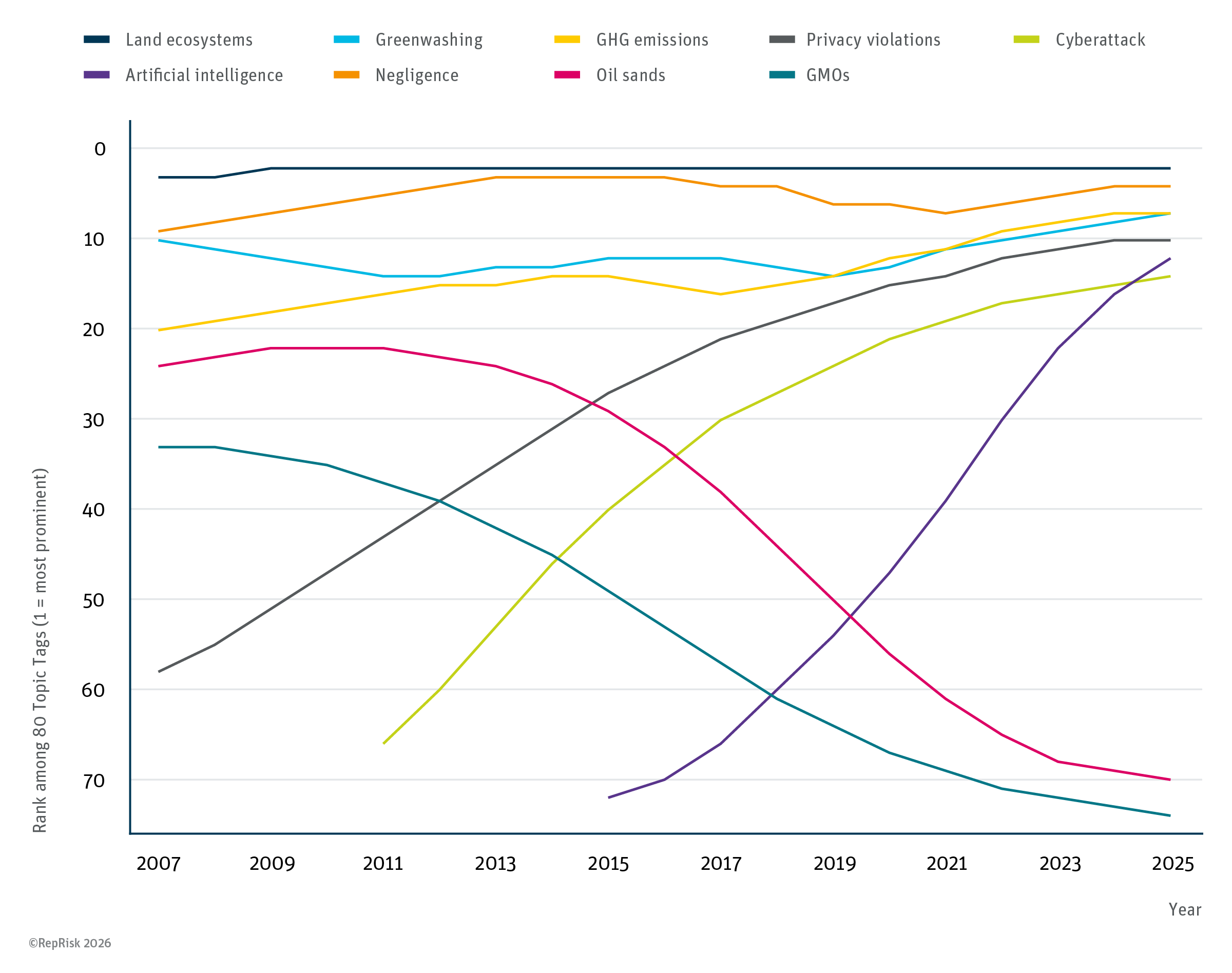
A single-year snapshot cannot show whether a risk is returning, emerging, enduring, or fading.
A single ranking can show which risks are most visible today. But it cannot show whether that visibility reflects a risk that is returning, accelerating, fading, or remaining persistently material. That is where long-term data changes the picture.
Looking across 20 years of RepRisk data reveals very different Topic Tag trajectories. Some risks faded from view before returning. Greenwashing, for example, moved down the rankings in the middle of the period before rising again in recent years; Greenhouse gas (GHG) emissions followed a similar pattern. This reflects a broader shift in financial markets: sustainability claims, climate disclosures, emissions data, and sustainability-related products have become subject to greater scrutiny from investors, regulators, and supervisors.
Other risks moved in the opposite direction. Privacy violations, once lower in the rankings, have become one of the most prominent Topic Tags in the dataset. Cyberattack climbed sharply as digital connectivity, technological dependency, and financial-sector exposure to cyber incidents increased. Artificial intelligence, introduced into the RepRisk taxonomy in 2015, has also accelerated. As AI moves deeper into financial markets, governance, model risk, data security, confidentiality, and reputational risk have become increasingly important areas of oversight.
Some risks, by contrast, have faded. Oil sands fell significantly in the rankings and did not return, while Genetically modified organisms (GMOs) also declined over time. These trajectories do not necessarily mean that the underlying issues disappeared. Rather, they may indicate that market attention shifted, regulatory frameworks matured, or the topic became absorbed into broader risk categories. Oil sands, for example, now sits within a wider conversation about energy transition, oil demand, emissions intensity, and climate-related financial risk. GMOs, meanwhile, have become increasingly governed by established regulatory and scientific-assessment frameworks.
And then there are risks that never really leave. Land ecosystems has never ranked lower than second in the RepRisk data over the past 20 years. That persistence mirrors the growing recognition that nature-related risks are also financial risks. Biodiversity loss, ecosystem degradation, water stress, and land-use change can affect everything from supply chains and agricultural production to credit risk and long-term economic resilience. Increasingly, financial institutions are recognizing that their portfolios depend on the health of the natural systems that support economic activity.
For banks, asset managers, and other decision-makers, these differences matter. A returning risk, an emerging risk, a fading risk, and a persistent risk require different lenses. A single-year ranking can make them look alike. Long-term trajectories tell them apart.
By looking beyond the snapshot, decision-makers can better distinguish signal from noise, identify emerging exposures earlier, and understand which issues may shape tomorrow’s material risks. In a world where market attention moves quickly but many risks evolve over years, maintaining that longer-term perspective can provide a meaningful advantage.
Copyright 2026 RepRisk AG. All rights reserved. RepRisk AG owns all intellectual property rights to this report. This information herein is given in summary form and RepRisk AG and/or the third party contributors to this report make no representation or warranty that any data or information supplied to or by it or them is complete or free from errors, omissions, or defects. Without limiting the foregoing, in no event shall RepRisk AG and/or the third party contributors to this report have any liability (whether in negligence or otherwise) to any person in connection with the information contained herein. Any reference to or distribution of this report must include a link to the content to provide sufficient context. The information provided in this presentation does not constitute an offer or quote for our services or a recommendation regarding any investment or other business decision, and is not intended to constitute or to be used as a substitute for legal, tax, accounting, or other professional advice. Please note that the information may have become outdated since its publication. Should you wish to obtain a quote for our services, please contact us.
Decision‑grade means suitable for identifying and prioritizing risk exposure as an input into a broader decision‑making process. RepRisk data does not determine legality, compliance, thresholds, or required actions, and does not prescribe investment, procurement, or engagement decisions.